The Triumph Tracker 400 vs Speed 400 comparison has quickly become one of the most discussed topics among bike enthusiasts in India. Both motorcycles belong to Triumph’s new 400cc lineup developed in collaboration with Bajaj Auto.
To give you a clear answer right at the start: the Speed 400 is better suited for city riding and highway cruising, while the Tracker 400 is ideal for those who love off-road adventures and weekend trails.
In this detailed comparison of Triumph Tracker 400 vs Speed 400, we will cover everything from design and performance to weight and features, helping you decide which Triumph 400cc bike suits your lifestyle better.
Overview of Triumph 400cc Bikes
Triumph’s entry into the 400cc category marks a new chapter for affordable performance biking in India. The company has launched two distinct models under its 400cc portfolio.
- Speed 400: A refined street bike built for urban riders.
- Tracker 400: A scrambler-style motorcycle designed for mixed terrains.
These Triumph 400cc bikes are built on the same platform but feature different ergonomics and suspension setups. This approach to diversification is similar to what we see in the SUV space, such as in the Mahindra XUV 7XO vs XUV700 comparison.
| Model | Type | Price (Approx.) | Riding Focus |
|---|
| Triumph Speed 400 | Roadster | ₹2.33 Lakh | Urban and highway riders |
| Triumph Tracker 400 | Scrambler | ₹2.60 Lakh | Off-road and adventure riders |
Triumph Tracker 400 vs Speed 400 Design
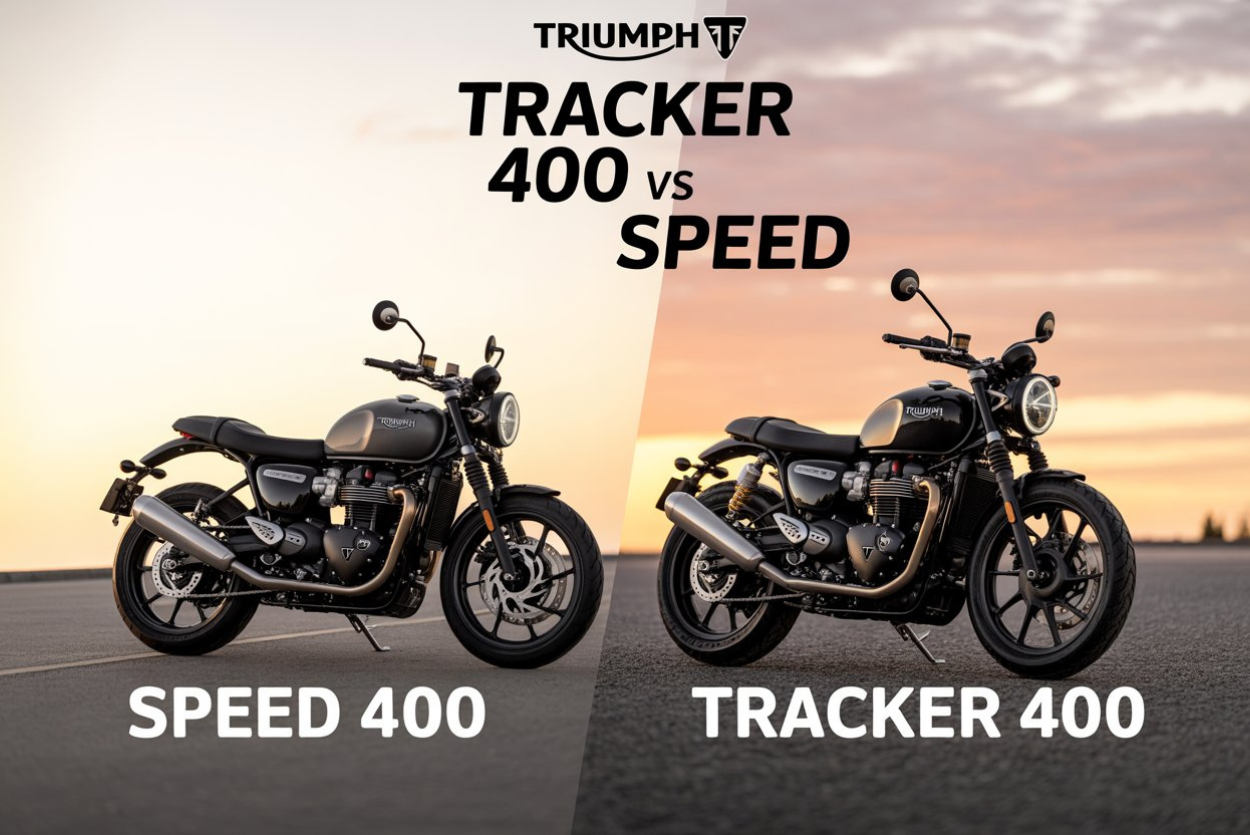
The Triumph Tracker 400 vs Speed 400 design comparison highlights two very different personalities. Both carry Triumph’s signature British styling but appeal to different audiences.
Speed 400 Design Highlights
- Compact, muscular design suited for city rides.
- Low-slung exhaust for sporty road presence.
- Alloy wheels designed for precision and speed.
- Simple, modern look with a flat seat profile.
Tracker 400 Design Highlights
- High-mounted exhaust for off-road protection.
- Wide handlebar for better control on rough roads.
- Spoked wheels and knobby tires for grip.
- Tall stance with upright seating position.
| Design Element | Speed 400 | Tracker 400 |
|---|
| Wheel Type | 17-inch alloy | 19-inch front, 17-inch rear spoke |
| Seat Height | 790 mm | 835 mm |
| Exhaust | Low-mounted | Upswept |
| Ground Clearance | 170 mm | 195 mm |
The Tracker 400 looks rugged and purpose-built, while the Speed 400 appears sleek and performance-driven. This distinction mirrors the philosophy seen in the Suzuki Baleno Latin NCAP Rating review, where design and practicality meet.
Tracker 400 vs Speed 400 Engine Comparison
In terms of Tracker 400 vs Speed 400 engine comparison, both bikes share the same 398cc single-cylinder liquid-cooled engine but are tuned for different riding experiences.
| Specification | Speed 400 | Tracker 400 |
|---|
| Engine Type | Single-Cylinder, DOHC | Single-Cylinder, DOHC |
| Displacement | 398cc | 398cc |
| Power | 40 PS @ 8,000 rpm | 39.5 PS @ 8,000 rpm |
| Torque | 37.5 Nm @ 6,500 rpm | 37 Nm @ 6,500 rpm |
| Gearbox | 6-Speed | 6-Speed |
The Speed 400 offers sharper acceleration and quick throttle response, while the Tracker 400 specifications prioritize steady low-end torque for control on loose terrain. Both engines use a slipper clutch and smooth gear transitions.
Triumph Tracker 400 vs Speed 400 Performance
When we compare Triumph Tracker 400 vs Speed 400 performance, it becomes clear that each model caters to a specific type of rider.
- Speed 400 Performance: Agile, lightweight, and quick to respond on highways.
- Tracker 400 Performance: Stable, comfortable, and capable on rough terrains.
| Parameter | Speed 400 | Tracker 400 |
|---|
| Top Speed | 150+ km/h | 145 km/h |
| 0–100 km/h | 6.5 seconds | 7 seconds |
| Suspension | USD forks (130 mm travel) | USD forks (150 mm travel) |
| Tires | Road-focused | Dual-purpose |
| Brakes | 300 mm front, 230 mm rear | 320 mm front, 230 mm rear |
The difference in tuning allows both motorcycles to stand out. The Speed 400 is more refined for highways, while the Tracker 400 delivers confidence on unpredictable paths, much like how the 2026 Maruti Suzuki Brezza Review highlights city efficiency versus outdoor durability.
Triumph Tracker 400 vs Speed 400 Features
Both motorcycles share Triumph’s latest technology package, yet differ slightly in terms of off-road readiness.
Shared Features
- LED headlamp, tail lamp, and indicators.
- Ride-by-wire throttle system.
- Dual-channel ABS with traction control.
- Slip and assist clutch.
- USB-C charging port.
| Feature | Speed 400 | Tracker 400 |
|---|
| Traction Control | Yes | Yes (Switchable) |
| ABS | Dual Channel | Dual Channel (Off-road mode) |
| Display | Semi-digital | Semi-digital |
| USB Charging | Yes | Yes |
The Speed 400 features make it perfect for modern urban use, while the Tracker 400 features are tailored toward off-road adaptability. The attention to rider experience feels similar to innovations like the KTM 160 Duke TFT Display Variant.
Tracker 400 vs Speed 400 Dimensions
The Tracker 400 vs Speed 400 dimensions comparison reveals how Triumph engineered each motorcycle for a distinct purpose.
| Dimension | Speed 400 | Tracker 400 |
|---|
| Seat Height | 790 mm | 835 mm |
| Wheelbase | 1378 mm | 1400 mm |
| Ground Clearance | 170 mm | 195 mm |
| Kerb Weight | 170 kg | 179 kg |
The Speed 400 offers a comfortable seat height for most riders, while the Tracker 400 provides higher ground clearance and a taller stance for tackling rough roads.
Tracker 400 vs Speed 400 Weight Difference
The Tracker 400 vs Speed 400 weight difference is only 9 kilograms but affects handling noticeably.
| Model | Weight |
|---|
| Speed 400 | 170 kg |
| Tracker 400 | 179 kg |
The additional weight on the Tracker 400 comes from its stronger suspension setup and dual-purpose wheels. Despite this, the balance is excellent, similar to the lightweight handling discussed in the Electric Scooter in Chennai article.
Performance Comparison Chart
| Category | Speed 400 | Tracker 400 | Verdict |
|---|
| Design Appeal | Sleek, modern | Rugged, bold | Tie |
| Engine Power | 40 PS | 39.5 PS | Speed 400 |
| Comfort | Moderate | High | Tracker 400 |
| Off-road Ability | Low | Excellent | Tracker 400 |
| Handling | Agile | Stable | Speed 400 |
| Value for Money | High | Good | Speed 400 |
Market Relevance and Comparisons
Triumph’s approach of offering two motorcycles on the same base platform shows its focus on diversity and consumer choice. Similar trends can be seen in the automotive industry with models like the Maruti Suzuki Victoris ICOTY 2026 and premium options such as the Jetour G700 Price in India.
This strategy of offering variants for different preferences mirrors the versatility found in innovations like Three Wheel Electric Scooters and Electric E-Rickshaw Price, where brands cater to both comfort and performance seekers.
Expert Verdict
The choice between Triumph Tracker 400 vs Speed 400 depends entirely on your riding needs.
- Choose the Speed 400 if you mostly ride in the city or enjoy sporty handling and faster response.
- Choose the Tracker 400 if you want an all-rounder motorcycle that can handle highways, trails, and weekend off-roading.
Both models continue Triumph’s tradition of engineering excellence, similar to how the 2026 F1 Driver Numbers lineup reflects innovation and individuality in racing.
Frequently Asked Questions
1. What are the main differences between Triumph Tracker 400 and Speed 400?
The Tracker 400 is built for off-road adventures, while the Speed 400 is optimized for street and highway use.
2. Which Triumph 400cc bike is faster?
The Speed 400 has a slightly higher top speed at around 150 km/h compared to the Tracker’s 145 km/h.
3. Do both motorcycles have the same engine?
Yes, both share the same 398cc single-cylinder engine with different tuning for performance.
4. What is the Tracker 400 vs Speed 400 weight difference?
The Tracker 400 weighs 9 kilograms more due to its heavier suspension and dual-purpose tires.
5. What are the standout Speed 400 features?
LED lighting, ride-by-wire throttle, traction control, and a slipper clutch make the Speed 400 ideal for city riders.
6. Which bike offers more comfort for long rides?
The Tracker 400 provides a taller seat and longer suspension travel, making it more comfortable on rough roads.
7. What is the price difference between the two bikes?
The Speed 400 is priced around ₹2.33 lakh, while the Tracker 400 costs about ₹2.60 lakh (ex-showroom).
8. Which Triumph 400cc bike offers better value for money?
The Speed 400 provides higher value for daily commuting, while the Tracker 400 offers better versatility for adventure riders.
Conclusion
The Triumph Tracker 400 vs Speed 400 comparison clearly shows that both motorcycles deliver incredible value and performance in their respective categories.
If you are looking for a stylish, performance-focused urban bike, the Speed 400 is the better choice. But if your rides often take you off the tarmac and onto challenging trails, the Tracker 400 stands as the stronger contender.
Both are well-engineered Triumph 400cc bikes that combine power, technology, and classic design. Much like the Jetour X50 Price article’s insight into diverse market appeal, these two Triumphs perfectly balance performance with purpose.