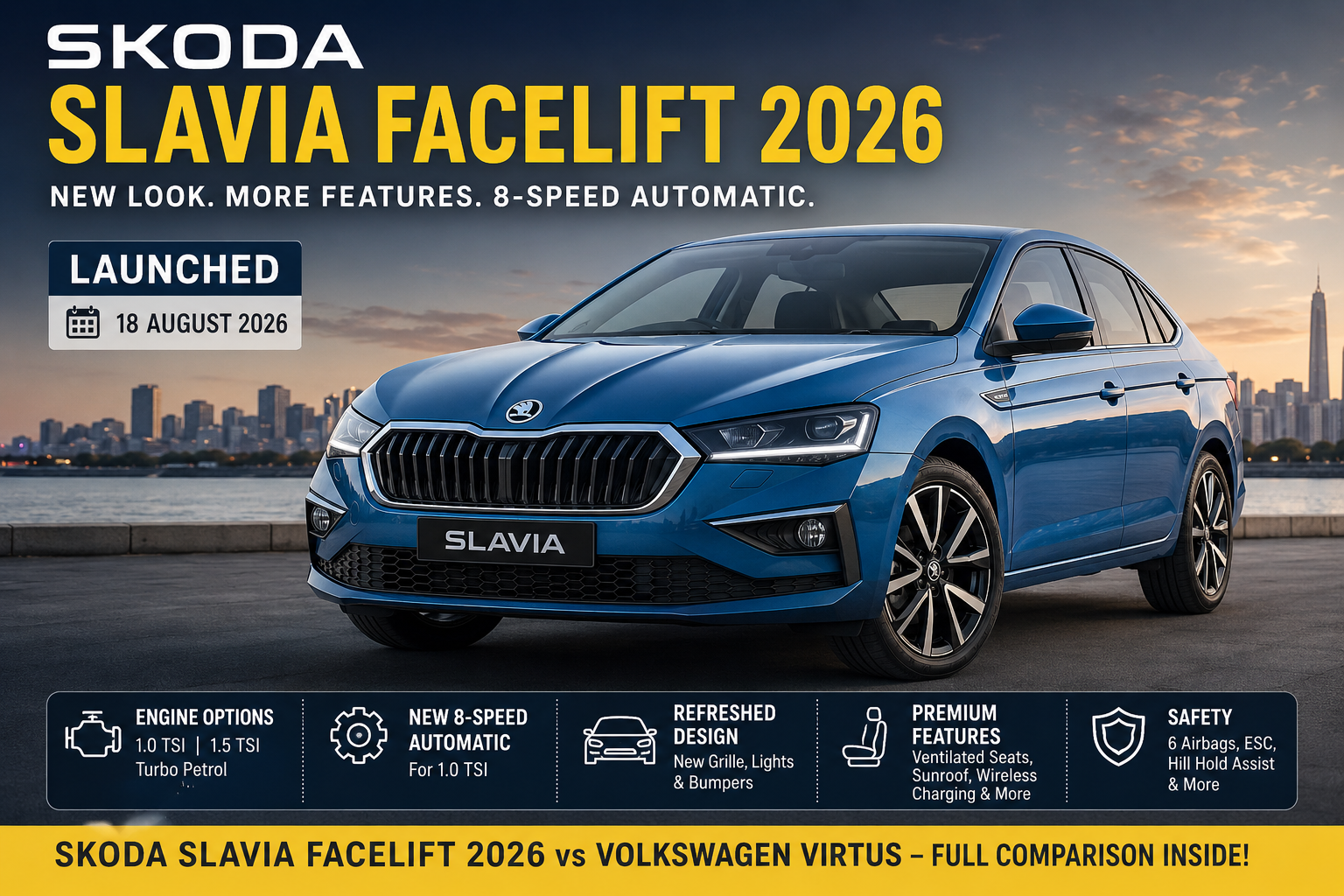
The Skoda Slavia facelift has arrived in India with refreshed styling, additional features and an important transmission update. The Skoda Slavia facelift 2026 continues with the familiar 1.0-litre and 1.5-litre TSI petrol engines, while the 1.0 TSI gets a new 8-speed automatic gearbox. The updated sedan also receives exterior design revisions, cabin upgrades and additional technology.
For buyers researching the latest Skoda Slavia facelift, the biggest questions are simple: What has changed, how much does it cost, which engine should you choose, and how does it compare with the Volkswagen Virtus? Here is everything you need to know.
Skoda Slavia Facelift 2026: What’s New?
The Skoda Slavia facelift 2026 is a mid-life update rather than a completely new generation. Skoda has concentrated on sharpening the sedan’s appearance, adding equipment and improving its automatic transmission offering.
The Skoda Slavia facelift retains its familiar sedan proportions and platform while introducing several visual and mechanical improvements. The most significant mechanical talking point is the new automatic option for the smaller turbo-petrol engine.
Major Updates at a Glance
| Area | Update |
|---|
| Body style | Midsize sedan |
| Fuel type | Petrol |
| Engines | 1.0 TSI and 1.5 TSI |
| New automatic | 8-speed automatic for 1.0 TSI |
| 1.5 TSI automatic | 7-speed DSG |
| Exterior | Revised grille, lighting and bumpers |
| Interior | Updated equipment and trims |
| Safety | Multiple active and passive safety features |
| Launch | August 18, 2026 |
The Skoda Slavia facelift 2026 is therefore designed to improve an already established package rather than completely change the sedan’s identity.
Skoda Slavia Facelift Launch Date
The Skoda Slavia launch took place on August 18, 2026, following several weeks of teasers and reports about the upcoming update. The Slavia facelift launch marks an important update for the sedan as competition in India’s midsize-sedan segment continues to grow.
The Skoda Slavia facelift launch is significant because buyers now expect midsize sedans to offer advanced technology, turbo-petrol engines, automatic transmissions, premium interiors and strong safety equipment.
Skoda Slavia Facelift Teaser: What Did It Reveal?
The Skoda Slavia facelift teaser campaign gave early clues about the revised exterior. The Skoda Slavia teaser material highlighted changes to the grille, lighting and other styling elements before the official reveal.
The teasers also helped create interest around the updated model by gradually revealing new details.
The latest Skoda Slavia new details indicate that the update goes beyond a cosmetic revision, with new equipment and a revised transmission strategy also forming part of the package.
Skoda Slavia Facelift Exterior Design
The Skoda Slavia facelift receives a sharper appearance while retaining its familiar silhouette. Skoda has focused on subtle but noticeable changes rather than giving the sedan an entirely new design.
The Slavia facelift design focuses on details that make the car appear fresher and more premium.
Revised Front-End Design
The front section receives several noticeable changes, including:
- Revised grille treatment
- Updated LED lighting
- Redesigned bumper detailing
- Revised lower air intake
- Updated chrome accents
- Sharper lighting elements
The revised front-end gives the sedan a more contemporary appearance while maintaining Skoda’s recognizable design language.
New Side Profile Details
The side profile remains largely recognizable, but new alloy-wheel designs help distinguish the updated model.
Other changes include:
- Revised wheel designs
- Updated chrome detailing
- Subtle exterior trim changes
- Fresh colour options
- Refined side detailing
Revised Rear Design
At the rear, the Slavia facelift features updated tail-lamp detailing and other styling revisions.
The overall approach remains evolutionary. Skoda has retained the Slavia’s long bonnet, clean shoulder line and traditional three-box sedan shape instead of turning it into a crossover-style vehicle.
Skoda Slavia Facelift Interior and Features
The cabin of the Skoda Slavia facelift 2026 keeps the general dashboard architecture of the existing car, but the equipment list and trim details have been updated.
The Skoda Slavia features list remains one of the sedan’s major selling points, particularly for buyers who want premium equipment in a relatively compact package.
Dashboard and Digital Display
The updated cabin can include:
- Digital driver’s display
- Updated infotainment system
- Wireless smartphone connectivity
- Revised interior trims
- Updated upholstery
- Multifunction steering wheel
The larger digital display gives the driver access to important vehicle information while adding a more modern feel to the dashboard.
Comfort and Convenience Features
The Skoda Slavia features package includes equipment such as:
- Ventilated front seats
- Automatic climate control
- Wireless phone charging
- Electric sunroof
- Cruise control
- Premium upholstery
- Rear AC vents
- Parking sensors
- Camera assistance
Feature availability can vary according to the selected variant, so buyers should check the equipment list carefully before booking.
Safety Features
Safety remains an important part of the Skoda Slavia facelift package.
Key safety equipment includes:
- Six airbags
- Electronic stability control
- Traction control
- Hill-hold assistance
- Electronic differential lock
- Multi-collision braking
- Tyre-pressure monitoring
- Parking sensors
- Camera assistance
Higher variants can also offer additional driver-assistance technology.
Skoda Slavia Engine Options
The Skoda Slavia engine lineup continues with two turbocharged petrol engines.
The smaller engine focuses on balanced everyday performance, while the larger engine is designed for buyers who want stronger acceleration.
Skoda Slavia 1.0 TSI
The Skoda Slavia 1.0 TSI uses a 1.0-litre turbo-petrol engine producing around 116hp and 178Nm.
The engine is available with a manual transmission and is now paired with the new automatic transmission option.
The Slavia 1.0 TSI makes sense for buyers who mainly drive in cities but also want enough performance for highway trips.
Skoda Slavia 1.5 TSI
The Skoda Slavia 1.5 TSI remains the more powerful option.
It produces approximately:
- 150hp
- 250Nm
- Turbo-petrol performance
- 6-speed manual transmission
- 7-speed DSG automatic transmission
The Skoda Slavia 1.5 TSI is better suited to buyers who prioritize acceleration and highway performance.
Skoda Slavia 8-Speed Automatic Explained
One of the most important updates is the Skoda Slavia 8-speed automatic.
The updated 1.0 TSI gets an 8-speed torque-converter automatic gearbox, making it one of the most significant mechanical changes in the facelift.
The Skoda Slavia automatic option should appeal strongly to city buyers who spend considerable time in stop-and-go traffic.
Why the 8-Speed Automatic Matters
An 8-speed automatic provides more ratios than a 6-speed setup and can help the engine operate across a wider range of speeds.
Potential advantages include:
- Smoother gear changes
- More flexible gearing
- Comfortable highway cruising
- Easier urban driving
- Better control of engine speed
Actual fuel economy and performance should always be judged through real-world testing.
8-Speed Automatic vs 6-Speed Automatic
| Feature | 8-Speed Automatic | 6-Speed Automatic |
|---|
| Gears | 8 | 6 |
| Application | Updated 1.0 TSI | Earlier 1.0 TSI setup |
| Main appeal | Wider gearing | Conventional automatic |
| Suitable for | City and highway | Everyday driving |
| Driving focus | Smoothness and flexibility | Familiar automatic operation |
The new gearbox could become one of the strongest reasons for buyers to consider the facelift.
Skoda Slavia Facelift Price
The Skoda Slavia price places the sedan in India’s premium midsize-sedan segment.
The facelift is expected to command a higher price than the outgoing model because of the additional equipment, updated styling and new transmission.
The final Skoda Slavia facelift price depends on the selected variant, engine and transmission.
What Does the Slavia Price Include?
The Slavia price displayed by the manufacturer is generally an ex-showroom figure. Buyers should also consider:
- Registration charges
- Road tax
- Insurance
- Accessories
- Extended warranty
- Service packages
- Applicable dealer charges
The final on-road price can therefore be considerably higher than the advertised ex-showroom figure.
Skoda Slavia Facelift vs Volkswagen Virtus
The Skoda Slavia facelift vs Volkswagen Virtus comparison is unavoidable because both sedans share important technical characteristics and compete directly in the same segment.
The Volkswagen Virtus remains one of the closest alternatives for anyone considering the updated Slavia.
Slavia 1.0 TSI vs Virtus 1.0 TSI
The Virtus 1.0 TSI and Slavia’s 1.0-litre turbo-petrol engine have similar core performance characteristics.
Both offer:
- 1.0-litre turbo-petrol engines
- Around 116hp
- Around 178Nm
- Manual transmission options
- Automatic transmission options
The transmission setup becomes one of the most interesting differences after the facelift.
Skoda Slavia Automatic vs Virtus Automatic
The new Skoda Slavia automatic configuration gives the facelift an interesting advantage on paper.
The Virtus automatic has traditionally used a 6-speed torque-converter automatic with its 1.0 TSI, while the updated Slavia moves to an 8-speed automatic.
However, a higher number of gears does not automatically mean that one car is better. Gearbox tuning, price, equipment and driving characteristics are equally important.
Skoda Slavia Facelift vs Volkswagen Virtus: Features
The Skoda Slavia facelift vs Volkswagen Virtus comparison also comes down to equipment and styling.
| Area | Skoda Slavia Facelift | Volkswagen Virtus |
|---|
| Design | Refreshed Skoda styling | Sporty Volkswagen styling |
| 1.0 TSI | Yes | Yes |
| 1.5 TSI | Yes | Yes |
| Automatic | 8-speed for 1.0 TSI | 6-speed for 1.0 TSI |
| 1.5 automatic | 7-speed DSG | 7-speed DSG |
| Safety | Strong safety package | Strong safety package |
| Buyer focus | Features and dynamics | Styling and dynamics |
The Skoda Slavia facelift vs Volkswagen Virtus decision should ultimately depend on comparable variant pricing and equipment.
Skoda Slavia Facelift vs Its Rivals
The Skoda Slavia rivals include the Volkswagen Virtus, Hyundai Verna and Honda City.
Each model takes a slightly different approach to the midsize-sedan segment.
Volkswagen Virtus
The Volkswagen Virtus appeals to buyers who prefer sporty styling, strong driving dynamics and Volkswagen’s design language.
Its close technical relationship with the Slavia makes the two cars natural competitors.
Hyundai Verna
The Hyundai Verna focuses heavily on technology, comfort and modern styling.
It is particularly appealing to buyers who prioritize a feature-rich cabin and contemporary design.
Honda City
The Honda City remains a popular family-oriented choice thanks to its spacious cabin, comfort and established reputation.
Skoda Slavia Rivals Comparison
| Sedan | Main Strength |
|---|
| Skoda Slavia | Driving dynamics and turbo-petrol engines |
| Volkswagen Virtus | Sporty design and driving character |
| Hyundai Verna | Features and technology |
| Honda City | Comfort and family practicality |
Skoda Slavia Facelift Mileage and Everyday Usability
Mileage remains an important consideration for Indian sedan buyers.
The Skoda Slavia facelift 2026 can deliver different efficiency depending on the engine and transmission combination.
Real-world mileage depends on:
- Traffic conditions
- Driving style
- Air-conditioning use
- Tyre pressure
- Road conditions
- Vehicle load
- Transmission behavior
The 1.0 TSI should appeal to buyers seeking a balanced everyday car, while the 1.5 TSI is better suited to performance-focused drivers.
Rather than relying only on laboratory figures, buyers should consider real-world fuel economy after extended ownership and independent testing.
Skoda Slavia Facelift: Confirmed vs Expected Changes
The Skoda Slavia facelift 2026 generated considerable interest before launch, so separating confirmed changes from earlier expectations is important.
| Detail | Status |
|---|
| Facelifted exterior | Confirmed |
| Revised grille | Confirmed |
| Updated lighting | Confirmed |
| New alloy wheels | Confirmed/available |
| Updated interior | Confirmed |
| 1.0 TSI | Continues |
| 1.5 TSI | Continues |
| 8-speed automatic | Major update |
| 7-speed DSG | Continues with 1.5 TSI |
| Updated technology | Added/updated |
| Variant-specific equipment | Check individual variant |
| Final on-road price | Depends on location |
This approach makes the article more useful because readers can distinguish established information from earlier speculation.
Is the Skoda Slavia Facelift Worth Buying?
The Skoda Slavia facelift is worth considering if you want a sedan that combines turbo-petrol performance, premium equipment and strong driving dynamics.
Reasons to Consider It
- Updated exterior design
- New automatic transmission for the 1.0 TSI
- Powerful 1.5 TSI option
- Premium cabin
- Strong safety package
- Good highway manners
- Comfortable sedan layout
- Competitive feature list
Things to Consider
- The facelift can cost more than the outgoing model
- SUVs offer greater ground clearance
- Automatic variants can cost significantly more
- Equipment varies by trim
- The 1.5 TSI DSG is more performance-focused
The Skoda Slavia facelift makes the most sense for buyers who prefer the handling, driving position and road manners of a sedan over an SUV.
Importance of Factory-Fit Components
The Importance of factory-fit components becomes relevant when considering long-term ownership and replacement parts.
A vehicle’s exact variant, model year, engine and transmission can affect component compatibility.
For a Slavia owner, it is sensible to verify:
- VIN
- Model year
- Engine variant
- Transmission type
- Variant
- Original equipment part number
- Manufacturer specification
The Importance of factory-fit components is particularly important for engine, transmission, braking and electronic components. A part that physically fits a vehicle is not necessarily the correct factory specification.
For example, components designed for the 1.0 TSI should not automatically be assumed to match the 1.5 TSI simply because both engines are offered in the same model.
The Importance of factory-fit components therefore extends beyond performance. Correct components help preserve compatibility, reliability and the vehicle’s intended operating characteristics.
Skoda Slavia Facelift Pros and Cons
Pros
- Fresh exterior design
- New 8-speed automatic
- Strong 1.0 TSI engine
- Powerful 1.5 TSI option
- Premium cabin
- Good safety equipment
- Strong driving dynamics
- Competitive against other midsize sedans
Cons
- Higher equipment can increase the price
- Lower ground clearance than most SUVs
- Top variants can become expensive
- Some features remain trim-specific
- 1.5 TSI DSG may not suit buyers seeking maximum simplicity
Frequently Asked Questions
1. What is the Skoda Slavia facelift?
The Skoda Slavia facelift is the updated version of Skoda’s midsize sedan. It receives refreshed exterior styling, additional equipment and an important automatic-transmission update while retaining the 1.0 TSI and 1.5 TSI petrol engines.
2. When did the Skoda Slavia facelift launch in India?
The Skoda Slavia facelift launch took place on August 18, 2026. The update follows the original Slavia’s introduction to the Indian market.
3. What is the Skoda Slavia facelift price?
The Skoda Slavia facelift price depends on the variant, engine and transmission. Buyers should check the latest official variant-wise price list because automatic and higher-performance versions can cost considerably more.
4. What are the main Skoda Slavia features?
Important Skoda Slavia features include turbo-petrol engines, automatic climate control, wireless charging, ventilated seats, a sunroof, digital instrumentation, parking assistance and a comprehensive safety package, depending on the variant.
5. Does the Skoda Slavia facelift get an 8-speed automatic?
Yes. The updated 1.0 TSI is paired with the new Skoda Slavia 8-speed automatic. The 1.5 TSI continues with its 7-speed DSG automatic transmission.
6. What engines are available in the Skoda Slavia facelift?
The Skoda Slavia engine lineup continues with the 1.0-litre TSI and 1.5-litre TSI turbo-petrol engines. The smaller engine produces around 116hp and 178Nm, while the larger engine produces around 150hp and 250Nm.
7. How is the Skoda Slavia facelift different from the Volkswagen Virtus?
The Skoda Slavia facelift vs Volkswagen Virtus comparison mainly comes down to styling, equipment, pricing and transmission choices. Both share important technical characteristics, but the updated Slavia’s 1.0 TSI gets an 8-speed automatic.
8. Should you buy the Skoda Slavia facelift or wait for other rivals?
The Skoda Slavia facelift is worth considering if you want a turbo-petrol sedan with strong performance, premium features and updated technology. However, buyers should compare final variant prices and equipment with the Virtus, Verna and City before making a decision.
Final Verdict
The Skoda Slavia facelift is a meaningful update rather than a complete redesign. Its refreshed exterior, upgraded cabin equipment and new transmission option make it more competitive in India’s midsize-sedan market.
The biggest mechanical talking point is the Skoda Slavia 8-speed automatic, particularly for buyers interested in the 1.0 TSI. The larger 1.5 TSI continues to provide a stronger performance option with its DSG transmission.
For buyers comparing the Skoda Slavia facelift vs Volkswagen Virtus, the decision will come down to variant pricing, styling preference, equipment and gearbox choice. The Hyundai Verna and Honda City remain important alternatives as well.
The Skoda Slavia facelift 2026 is ultimately a sensible evolution of an established sedan. It keeps the qualities that made the Slavia popular while adding more technology, convenience and transmission flexibility.
With the Skoda Slavia facelift launch complete, buyers can now make a more informed decision based on the final variant equipment, pricing and test-drive experience.
For long-term ownership, the Importance of factory-fit components should also remain a priority. Choosing parts according to the exact VIN, engine, transmission and original equipment specification is a practical way to maintain compatibility and preserve the vehicle’s intended factory configuration.